The short answer
Solid wall insulation is insulation added to a wall that has no cavity — a single thickness of brick or stone with no air gap to fill. Most UK homes built before roughly 1920, and many up to the 1930s, have solid walls, which lose noticeably more heat than cavity walls. Because there is no gap to inject, the insulation is fixed either inside the wall (Internal Wall Insulation, IWI) or outside it (External Wall Insulation, EWI). IWI uses insulated boards or a built-up stud system on the inner face; EWI fixes insulation to the outer face and finishes it with render or cladding. Both can cut wall heat loss substantially, but each changes how the wall handles moisture, so the choice depends on the building's age, construction and finish.
Solid wall insulation is one of the bigger home-efficiency jobs in the UK, partly because solid-walled homes are common and partly because there are real trade-offs to weigh. Here is what it is and how the two methods differ.
Solid wall insulation at a glance
- Applies toWalls with no cavity (single-leaf)
- Common inHomes built before ~1920–1930s
- Two methodsInternal (IWI) or external (EWI)
- Heat loss cutWall U-value can fall well below 0.30 W/m²K
- Key risk to manageMoisture and condensation
Solid walls versus cavity walls
A cavity wall is built as two separate leaves — an outer and inner skin — with an air gap between them. From around the 1920s onwards this became the standard way to build in the UK, and the gap can usually be filled cheaply by injecting insulation through small holes. A solid wall has no such gap: it is a single thickness of brickwork (often around 220mm, laid in a Flemish or English bond) or solid stone. With nothing to inject, you cannot use cavity-fill methods, so the insulation has to be applied to one of the two faces of the wall.
The practical consequence is cost and disruption. A solid wall typically has a U-value of around 2.0 W/m²K or higher when uninsulated, against roughly 1.5 W/m²K for an unfilled cavity, so solid-walled homes feel colder and cost more to heat. The Energy Saving Trust lists solid wall insulation among the larger potential heating savings precisely because these walls start from such a poor baseline.
Internal wall insulation (IWI)
IWI is fitted to the inside face of external walls, room by room. The common approaches are rigid insulated plasterboard (a 'laminate' board bonded to insulation) fixed to the wall, or a timber/metal stud framework filled with insulation and then plasterboarded over. It is generally the lower-cost option per square metre and does not change the outside appearance, which matters in conservation areas and on attractive brick or stone frontages.
The trade-offs are real: IWI reduces internal floor area slightly, means redecorating and moving sockets, skirting, radiators and coving, and — most importantly — moves the cold side of the wall closer to the room, which can raise condensation risk within or behind the wall if detailing and ventilation are not handled carefully.
External wall insulation (EWI)
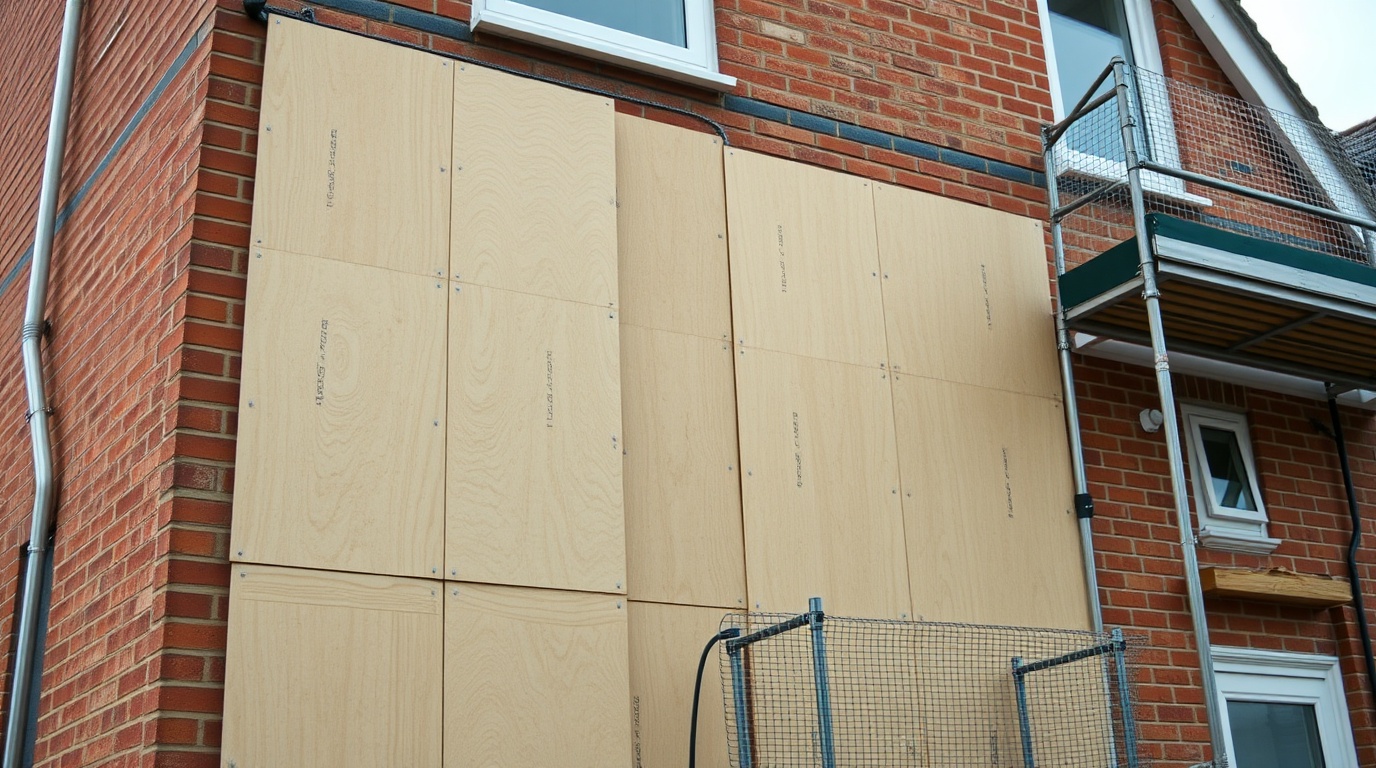
EWI fixes insulation boards to the outside of the wall, then covers them with a reinforced render or a cladding system. Because it wraps the whole building, it tends to give the most even improvement, keeps the existing masonry warm (which can help with damp), and avoids losing internal space. It is usually the more expensive method and changes the look of the house, so it often needs planning permission — and is generally not permitted on the front of a property in a conservation area or on a listed building without consent.
| Feature | Internal (IWI) | External (EWI) |
|---|---|---|
| Where it goes | Inside face of walls | Outside face of walls |
| Typical cost | Lower per m² | Higher per m² |
| Internal space | Reduced slightly | Unaffected |
| Appearance | Unchanged outside | Changed (render/cladding) |
| Disruption | High inside the home | Mostly external |
Indicative comparison for guidance. Sources: Energy Saving Trust solid wall insulation guidance.
Is solid wall insulation worth doing?
For a genuinely solid-walled home, the heat-loss reduction is one of the largest single efficiency gains available, and it makes rooms more comfortable and easier to keep warm. But it is also among the most involved and costly insulation jobs, and done badly it can cause damp. Good practice in the UK now follows PAS 2035, the retrofit standard that requires a proper assessment of the whole building — its construction, moisture behaviour and ventilation — before specifying a system. The sensible order is to confirm the walls really are solid, get a competent retrofit assessment, then decide between IWI and EWI based on the building rather than on price alone.
What the finished wall achieves
It is worth being concrete about the result. An uninsulated solid wall typically sits around a U-value of 2.0 W/m²K or higher, meaning it leaks heat quickly; a properly insulated solid wall can be brought down towards 0.30 W/m²K or lower, which is a large reduction in how fast heat escapes through that wall. In plain terms, rooms that were cold and slow to warm become easier and cheaper to keep comfortable, draughty cold spots near the walls disappear, and the inner surface stays warm enough that room moisture is far less likely to condense on it and grow mould.
The improvement you actually reach depends on the system and how thick it can be without losing too much room (for internal insulation) or projecting too far (for external). Thicker, higher-performance build-ups get closer to the best figures; thinner ones that fit a tight space insulate less. This is why a competent installer talks in terms of a target U-value for your specific wall rather than a single universal number — the right answer balances thermal performance against space, appearance, moisture safety and budget, all of which vary from house to house.
How solid wall insulation fits the whole house
Insulating the walls is rarely worth doing in isolation. A solid-walled home usually loses heat through the loft, the floor, the windows and through draughts as well as the walls, so the biggest, most cost-effective gains often come from the cheaper measures first — loft insulation, draught-proofing and a well-controlled heating system — before committing to wall insulation. This is the logic behind a whole-house retrofit plan: treat the building as one system, get the order right, and make sure each measure works with the others rather than against them.
Ventilation is the part most often forgotten. As you insulate and draught-proof, the home becomes more airtight, so it needs a deliberate way to remove the moisture that cooking, washing and breathing generate — typically extract fans in kitchens and bathrooms and background ventilation such as trickle vents. Wall insulation that is added without thinking about ventilation is the classic route to condensation and mould, which is exactly why the UK retrofit standards link the two together. Treated as part of a considered plan, solid wall insulation turns a cold, hard-to-heat house into a noticeably warmer and more efficient one; treated as a bolt-on, it can disappoint or cause problems.
Frequently asked questions
How do I know if my walls are solid?
Measure the wall thickness at a window or door reveal: solid brick walls are usually around 220mm and the brickwork often shows alternating short brick-ends (a header bond). Cavity walls are typically 250mm or more with a regular stretcher pattern. Homes built before about 1920 are most likely to be solid.
Is internal or external solid wall insulation better?
Neither is universally better. External (EWI) gives the most even result and keeps the masonry warm but costs more and changes the look. Internal (IWI) is cheaper and invisible outside but reduces room size and needs careful detailing to avoid condensation. The right choice depends on the building and any planning constraints.
Does solid wall insulation need planning permission?
Internal insulation usually does not. External insulation can need planning permission because it changes the building's appearance, and consent is generally required for listed buildings and for the front elevation in conservation areas. Building Regulations apply to both methods.
Sources & further reading
Figures on this page are typical UK ranges drawn from published sources and depend on your specific property. They are guidance, not a quotation.