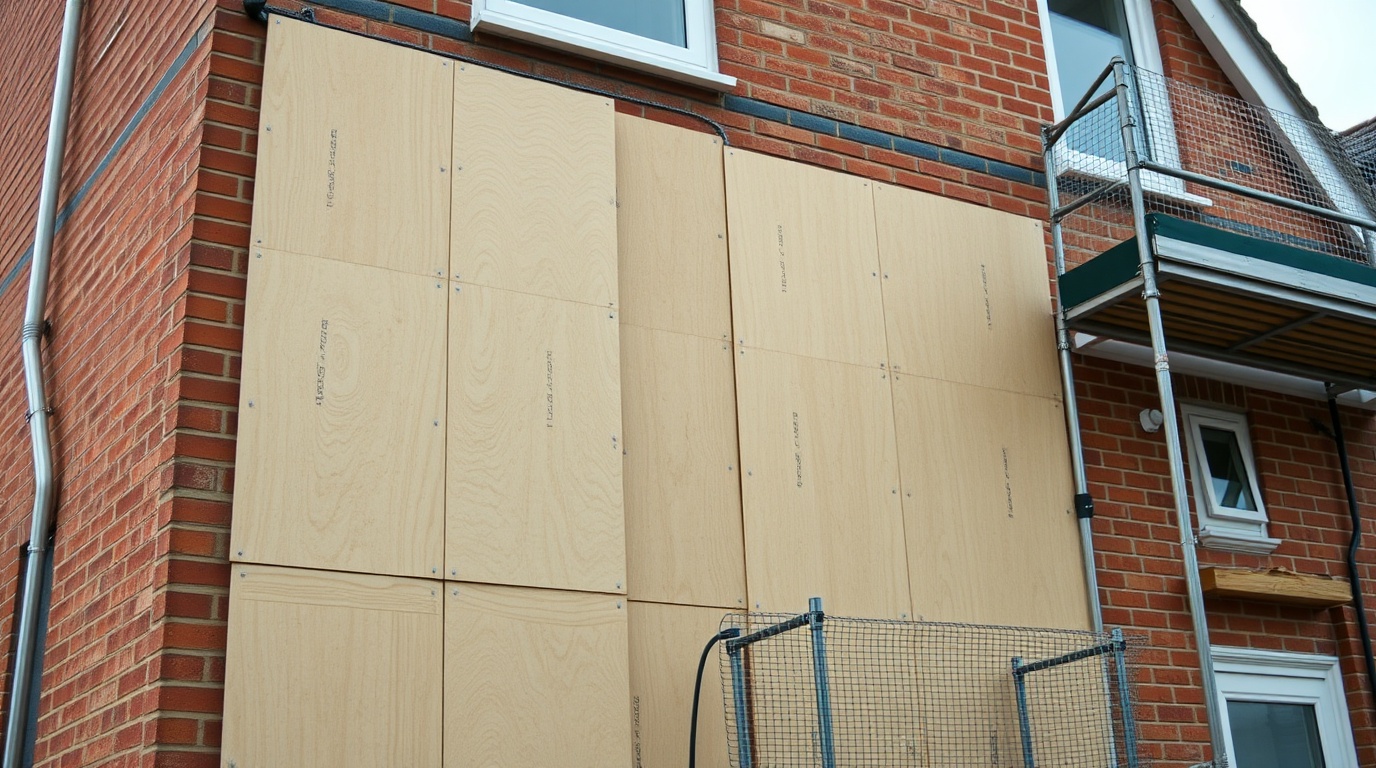
The short answer
External wall insulation on a UK terraced house usually costs around £6,000–£14,000, with a small mid-terrace sometimes nearer £6,000 and a larger end-terrace passing £16,000. A mid-terrace only has its front and rear walls exposed — the two side walls are shared party walls — so it has the least wall area of any house type and is the lowest-cost to insulate externally. An end-terrace adds an exposed gable wall, increasing the area and cost. The fitted rate is the usual £90–£150 per square metre. Access to the rear is often the practical complication on terraces. These are typical ranges, not fixed prices.
Terraces are the lowest-cost house type for external insulation because so much wall is shared — but rear access and the front street view bring their own wrinkles.
Typical terrace costs
- Mid-terrace£6,000–£11,000
- End-terrace£9,000–£16,000
- Per square metre fitted~£90–£150 / m²
- Mid-terrace exposed walls2 (front, rear)
- VAT (GB, qualifying)0% to 31 Mar 2027
Mid-terrace versus end-terrace
The big cost difference between terraces is how many walls are exposed. A mid-terrace sits between two neighbours, so both side walls are shared party walls and only the front and rear are insulated externally — the smallest wall area of any house type. An end-terrace has one open side, the gable wall, which is often a large, exposed, heat-losing face, so it costs more to insulate, sitting closer to a semi-detached. The party walls themselves are never insulated externally.
| Terrace type | Exposed walls | Typical total |
|---|---|---|
| Mid-terrace | 2 (front, rear) | £6,000–£11,000 |
| End-terrace | 3 (front, rear, gable) | £9,000–£16,000 |
| Per square metre | — | ~£90–£150 / m² |
| Gable end (end-terrace) | often largest face | key heat-loss area |
Indicative UK figures for guidance, 2026. Sources: published installer cost guides and Energy Saving Trust.
Access and the street frontage
Two practical issues are common on terraces. First, rear access: many terraces have a small back yard reached only through the house or a narrow alley, which makes getting scaffolding, boards and render to the rear wall slower and occasionally more expensive. Second, the front elevation usually faces directly onto the street or pavement, so scaffolding may need a pavement licence, and the rendered finish changes the look of the house within a row of similar properties — which can matter in a conservation area.
What moves the price on a terrace
Beyond mid versus end, the usual drivers apply. Insulation type (EPS lowest-cost, mineral wool non-combustible, phenolic thinnest), render finish (basic versus silicone, textured or brick-effect), and any prep to a damp, cracked or previously rendered wall all move the figure. Scaffolding on a two-storey terrace is a fixed cost, and restricted rear access can add to it. Region matters, with London and the South East at the upper end — relevant given how many terraces are in cities.
For grant-funded work under ECO4 or the Great British Insulation Scheme, the job must meet PAS 2030/2035 and be done by a TrustMark-registered installer. Qualifying EWI in Great Britain attracts 0% VAT on installed energy-saving materials under the relief running to 31 March 2027, which lowers the effective cost.
Is it worth it on a terrace?
Many terraces are older solid-wall properties that lose heat quickly through uninsulated brick, so even with only two exposed walls the benefit of insulating can be meaningful — and because the wall area is small, the cost is the lowest of any house type. Cutting the wall U-value from around 2.0 to roughly 0.30 W/m²K on the front and rear reduces heat demand and removes cold internal surfaces. On an end-terrace, insulating the exposed gable is often the single most valuable part of the job.
The trade-offs are the change to the street appearance, the rear-access logistics, and the fact that with party walls unaffected, two of the four walls are already protected by the neighbouring houses. Where the terrace already has filled cavity walls, EWI adds less. A survey will confirm whether the walls are solid or cavity and what U-value an external system would reach, and whether the front frontage faces any conservation constraints. The figures here are typical ranges to set expectations rather than a quotation.
Terraces also raise a coordination opportunity that other house types do not. Because rows of terraced houses are often near-identical and built at the same time, whole-row or block schemes can be more efficient than insulating a single house in isolation — scaffolding and installer mobilisation are shared, and the finished street stays visually consistent. In some areas, terraces have been insulated street-by-street through funded retrofit programmes for exactly this reason. If neighbours are interested, insulating several adjoining houses together can reduce the per-house cost and avoid the odd-one-out appearance of a single rendered frontage in a brick row. Even where a coordinated scheme is not possible, agreeing a consistent render colour or brick-effect finish with immediate neighbours helps keep the streetscape coherent, which both planning officers and future buyers tend to value.
Party walls, junctions and the practical detail on a terrace
The terraced layout creates a few technical points that shape both cost and quality. Where your insulated front or rear wall meets the party wall line with the neighbour, the installer has to terminate the render system cleanly at the boundary and detail the junction so rain cannot track behind it — a neat edge here matters both visually and for keeping water out. On an end-terrace, the gable often abuts a side passage or alley, and the available working width affects how easily scaffolding can be set and whether any oversailing of a neighbour's land is needed. These junctions are routine for an experienced installer but they take time, and a quote should show they have been considered rather than assuming a terrace is simply two plain walls.
There is also the question of shared services and features running along terrace frontages: gas and electricity meter boxes, shared downpipes and gullies, soil stacks, satellite dishes and cabling are common, and each has to be carefully removed and refixed onto the thicker insulated wall. On older terraces, decorative brick detailing, cills and door surrounds add labour just as they do on any period property. Because a mid-terrace has the smallest wall area of any house type, these fixed detailing costs make up a larger proportion of the total than on a big detached house — which is part of why the per-square-metre rate on a small terrace can sit towards the upper end even though the overall bill is the lowest. Understanding that helps explain why a terrace quote is not simply 'less wall, less money' in direct proportion to its size.
Frequently asked questions
How much does external wall insulation cost for a terraced house?
Typically around £6,000–£14,000 for a UK terrace. A small mid-terrace with only front and rear walls can be nearer £6,000, while a larger end-terrace with an exposed gable can pass £16,000.
Is a mid-terrace cheaper to insulate than an end-terrace?
Yes. A mid-terrace has only its front and rear walls exposed, as both sides are shared party walls, giving the smallest wall area of any house type. An end-terrace adds an exposed gable wall, increasing the area and cost.
Can I insulate only the front or rear of a terrace?
Often yes. Some owners insulate only the rear to keep a uniform brick street frontage, especially in conservation areas, or only an exposed gable on an end-terrace. The cost scales with the wall area treated.
Sources & further reading
Figures on this page are typical UK ranges drawn from published sources and depend on your specific property. They are guidance, not a quotation.