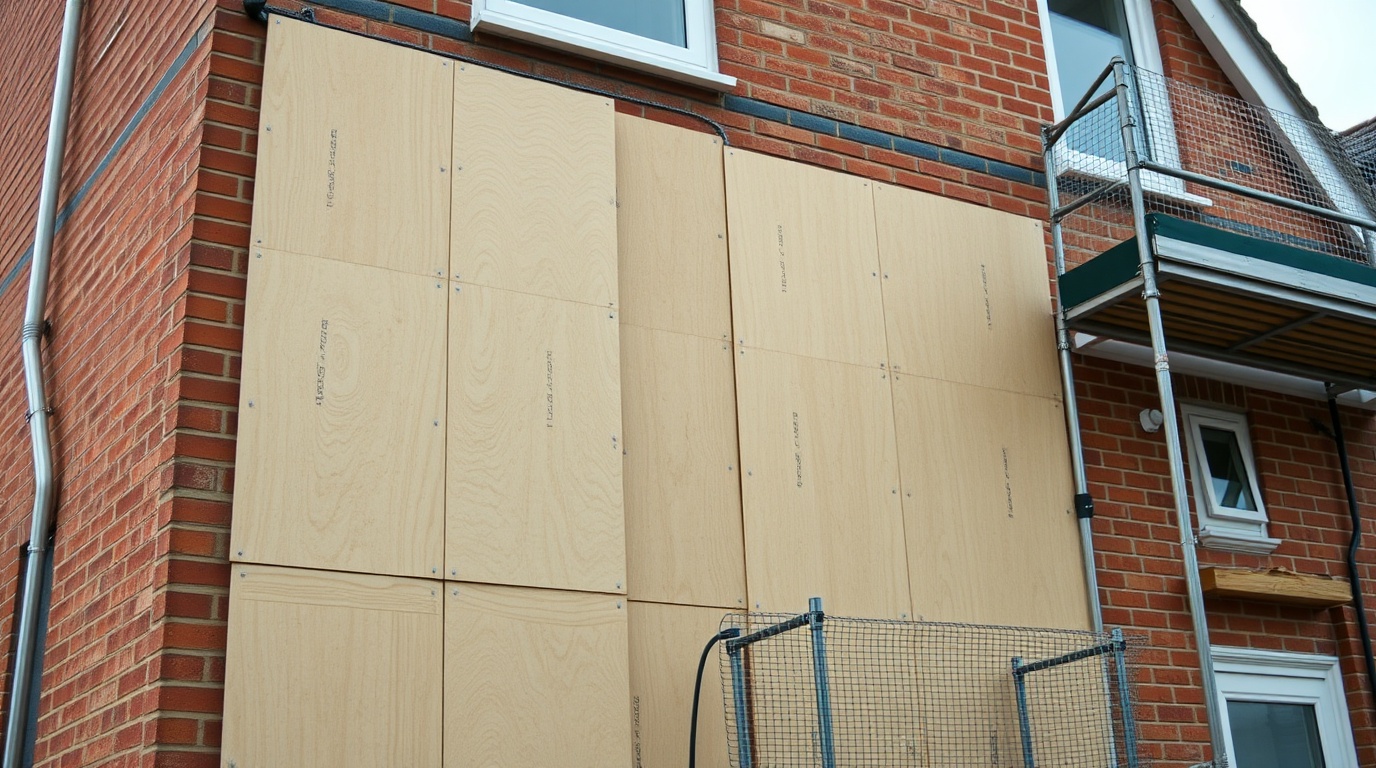
The short answer
External wall insulation (EWI) on a typical three-bedroom UK house usually costs somewhere around £10,000–£18,000, with smaller mid-terraces sometimes nearer £8,000 and larger detached or rendered three-beds passing £20,000. The work is priced mainly by wall area at roughly £90–£150 per square metre fitted, covering the insulation boards, render system, beads, mesh and labour. A three-bed semi typically has 90–120m² of external wall once you exclude windows and doors, which is what produces that headline range. Scaffolding, the type of insulation (EPS, mineral wool or phenolic), the render finish and any prep to a damp or uneven wall all move the figure. Because every house differs, treat these as typical ranges, not a fixed price.
The cost of insulating a three-bed externally depends mostly on how much wall you wrap, the system specified and how much access and prep the job needs. The figures below are typical UK ranges for guidance, not quotations.
Typical 3-bed costs
- Whole house (typical)£10,000–£18,000
- Per square metre fitted~£90–£150 / m²
- Typical wall area90–120 m²
- Insulation thickness90–120mm common
- VAT (Great Britain)0% to 31 Mar 2027
What makes up the cost
- Wall area: you largely pay per square metre, so a detached three-bed with four full elevations costs more than a mid-terrace with only front and back walls exposed.
- Insulation type: expanded polystyrene (EPS) is the lowest-cost board; mineral wool costs more but is non-combustible; phenolic is thinnest for a given U-value but dearer.
- Render finish: a basic mineral or polymer render is cheaper than silicone, brick-effect or a textured/ashlar finish.
- Access and prep: scaffolding, removing or extending sills, moving downpipes, gas meters and overhanging eaves all add cost, as does treating an uneven or damp wall first.
| Element | Typical figure | Notes |
|---|---|---|
| Mid-terrace (2 walls) | £8,000–£13,000 | front and rear only |
| Semi-detached | £10,000–£18,000 | 3 elevations typical |
| Detached | £14,000–£22,000+ | all four walls |
| Per square metre | ~£90–£150 / m² | includes boards, render, labour |
Indicative UK figures for guidance, 2026. Sources: Energy Saving Trust and published installer cost guides.
How the per-square-metre rate works
EWI is normally priced on the net wall area — the external wall surface minus the openings for windows and doors — at roughly £90–£150 per square metre fitted. That rate bundles the insulation boards, the basecoat render with embedded mesh, the beads and trims, the topcoat finish and the labour. A three-bed semi with around 100m² of net wall therefore lands near the middle of the headline range. The rate rises with thicker or higher-performance insulation, a premium render, and any complications such as bay windows, multiple corners or restricted access that slow the team down.
What else affects the final price
Beyond the wall area and system, several practical factors shift a three-bed quote. Scaffolding is usually included but adds materially to the cost on a two- or three-storey house. Detailing around windows, doors, eaves and the damp-proof course takes skilled time and is where quality is won or lost. If the existing wall is damp, cracked or previously rendered, it may need stripping or repair before boards go on. Properties that need a PAS 2030/2035 installation to qualify for any grant funding also carry survey and design costs, though those are often covered when the work is grant-funded.
Region matters too: London and the South East typically sit at the upper end, while parts of the North and the devolved nations can be lower. Finally, remember the 0% VAT relief on installed energy-saving materials in Great Britain, which runs to 31 March 2027 and reduces the bill compared with standard-rated building work.
Is it worth it on a three-bed?
EWI is one of the larger fabric upgrades a homeowner can make, so the value case rests on more than payback alone. On a solid-wall three-bed — typically a pre-1920s brick or stone property — uninsulated walls can lose a large share of the home's heat, and wrapping them externally can lift the wall U-value from around 2.0 W/m²K to roughly 0.30 W/m²K or better, depending on thickness. That cuts heat demand, makes rooms more even in temperature and removes cold internal surfaces where condensation forms.
The trade-offs are the upfront cost, the change to the building's external appearance, and the need to get detailing right so rain is kept out and the wall can still dry. For many three-bed solid-wall homes the combination of lower bills, a warmer house and a better EPC rating makes the work worthwhile, particularly if some of it is grant-funded. Where only one or two walls are solid, or the property already performs reasonably, the case is weaker and worth modelling before committing.
It is also worth budgeting for the things that sit just outside the headline £/m² figure on a three-bed. Window and door reveals have to be insulated and re-beaded, which can mean re-fitting sills and adjusting cills so rainwater still throws clear of the wall. Downpipes, soil stacks, satellite dishes, outside taps and gas or electricity meter boxes usually have to be removed and refixed onto the thicker wall, sometimes needing a gas-safe or electrician's visit. The eaves and verge may need extending so the roofline still overhangs the new, deeper wall. None of these is large on its own, but together they explain why two quotes for the 'same' three-bed can differ by a few thousand pounds, and why a detailed written specification is the only fair basis for comparison.
Reading a three-bed quote, and where the money can be saved
When you compare written prices for a three-bed, look past the headline total and check what each one actually includes. A complete EWI quote should set out the insulation board type and thickness, the render system and finish, the target U-value, the scope of scaffolding, and how the detailing at reveals, eaves, the damp-proof course and any bay windows will be handled. It should also confirm the installer is TrustMark-registered and that the work meets PAS 2030/2035, with a guarantee on the finished system. A price that is silent on these points is not necessarily cheaper — it may simply be leaving out work that a fuller quote has included, which then appears later as an extra.
There are a few legitimate ways the cost on a three-bed can come down without cutting corners. Doing it alongside other work — for example when scaffolding is already up for a re-roof, or when the property is being re-rendered anyway — spreads the fixed access cost across more than one job. Insulating only the solid elevations, where a house is part-cavity and part-solid, avoids paying to wrap walls that are already reasonably efficient. And securing grant funding through ECO4 or the Great British Insulation Scheme, where the household and property qualify, can cover part or all of the cost. What does not save money in the long run is choosing an under-specified system or an unregistered installer to shave the upfront figure, because poor detailing on a solid wall can lead to damp, render failure and remedial costs that dwarf the original saving.
Frequently asked questions
How much does external wall insulation cost for a 3 bed house?
A typical three-bed UK house usually costs around £10,000–£18,000 to insulate externally. A mid-terrace with only two exposed walls can be nearer £8,000–£13,000, while a detached three-bed with four elevations can pass £20,000.
How is external wall insulation priced?
It is priced mainly by net wall area at roughly £90–£150 per square metre fitted, covering boards, render, mesh, beads and labour. A three-bed semi typically has 90–120m² of wall once windows and doors are excluded.
Does external wall insulation add to the cost if my house is rendered already?
It can. An existing render that is sound may be left in place, but cracked, damp or loose render usually needs repair or removal first, which adds to the prep cost before the new system goes on.
Sources & further reading
Figures on this page are typical UK ranges drawn from published sources and depend on your specific property. They are guidance, not a quotation.